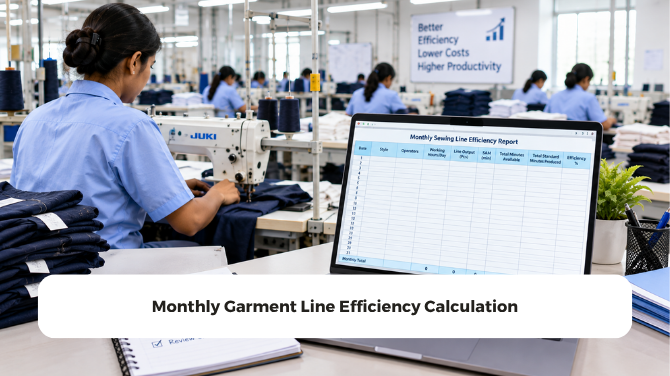
Monthly efficiency figures help garment factory management understand how well sewing lines and production floors are performing. They also help with labour cost control, factory capacity planning, and production targets. This guide explains how to prepare a monthly sewing line efficiency report and calculate the overall efficiency of a sewing floor.
Monthly Efficiency Calculation for a Sewing Line
Monthly efficiency figure is one of the basic and very important information to the management of the company. Efficiency figure shows how a line, a floor or a plant is performing compared to other lines and factory standards. Line efficiency level affects the labour cost of the garment. So each line supervisors are given monthly efficiency target to meet the target labour cost. Factory planning and factory capacity are also measured based online efficiency.
In this article, I have explained how the monthly efficiency report of a sewing line is prepared. And how to calculate monthly efficiency report of a sewing floor.
To know the monthly efficiency calculation method, read follow steps.
Step 1: Efficiency Calculation Formula
There is a standard formula to calculate the efficiency of a line. Efficiency is a ratio of total minute produced by line and total minutes available to the line. Efficiency is measured in percentage form.
Line efficiency% = (Total Standard minutes produced by a line / Total minutes available to the line) X 100
Step 2: Prepare Monthly Efficiency Calculation Table on Spreadsheet (Excel Sheet)
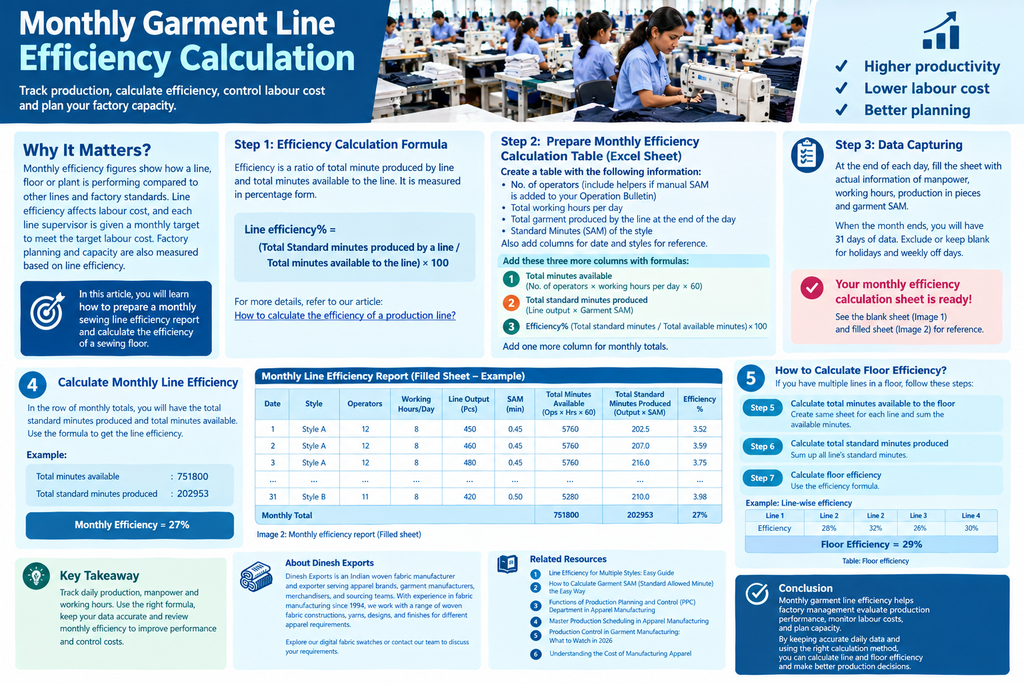
To track monthly production data and manpower details create one table on excl sheet as following that includes information
- No. of operators (include helpers if manual SAM is added to your Operation Bulletin) working in the line
- Total working hours per day
- Total garment produced by the line at the end of the day and
- Standard Minutes (SAM) of the style that is produced by that line
Also add columns for date and styles for reference.
Add three more columns on right side of the table and add formula into the cells of those columns as following
- Total minutes available ( No. of operators X working hours per day X 60)
- Total standard minutes produced (Line output X Garment SAM)
- Efficiency% (Total standard minutes /Total available minutes) * 100
Add 31 rows in the table after table header. Add dates from 1st to 31st on the first (date) column.
Add one more column for monthly totals.
Now your monthly efficiency calculation sheet is ready. See image-1: Blank efficiency report sheet.
Step 3: Data Capturing
At the end of each day fill this sheet date wise with actual information of manpower, working hours, production in pieces and garment SAM.
When month ends, you will have a sheet filled with 31 days data. Exclude or keep blank for holidays and weekly off days. See image – 2.
Step 4: Monthly Efficiency of a Line
In the row of monthly totals, you have whole month’s data of total minute produced and total minutes available to the line. On the efficiency column you will have monthly line efficiency.
In the above example:
- Total minutes available : 751800
- Total standard minutes produced : 202953
So, Monthly Efficiency this line is= 27 %
How to Calculate Floor Efficiency?
Now if you have multiple lines in a floor and you to calculate average efficiency of the floor then use following steps.
Step 5: Calculate Total Minutes Available to the Floor
- Create same sheet for each line as shown in image-1.
- Fill data line wise. Sum line wise monthly available minutes to calculate total available minutes for a floor.
Step 6: Calculate Total Standard Minutes Produced by the Floor
Sum up all line’s line wise standard minutes produced to calculate total standard minutes for the floor.
Step 7: Calculate Floor Efficiency
Finally, use the efficiency calculation formula to calculate sewing floor efficiency.
For example, You have four lines on one floor and line-wise efficiency are as follows.
Related Resources
For more information on garment production, efficiency, and planning, explore these related articles from Dinesh Exports:
- Line Efficiency for Multiple Styles: Easy Guide
- How to Calculate Garment SAM (Standard Allowed Minute) the Easy Way
- Functions of Production Planning and Control (PPC) Department in Apparel Manufacturing
- Master Production Scheduling in Apparel Manufacturing
- Production Control in Garment Manufacturing: What to Watch in 2026
- Understanding the Cost of Manufacturing Apparel
About Dinesh Exports
Dinesh Exports is an Indian woven fabric manufacturer and exporter serving apparel brands, garment manufacturers, merchandisers, and sourcing teams. With experience in fabric manufacturing since 1994, we work with a range of woven fabric constructions, yarns, designs, and finishes for different apparel requirements.
Consistent fabric quality is an important part of garment production. Fabric characteristics such as weight, construction, and finishing can influence cutting, sewing, garment appearance, and production performance. We work to support buyers with fabric solutions that meet their specifications and help them plan their production requirements with greater confidence.
If you are sourcing woven fabrics for your next collection, explore our digital fabric swatches or contact our team to discuss your requirements.
Conclusion
Monthly garment line efficiency helps factory management evaluate production performance, monitor labour costs, and plan capacity. By recording daily manpower, working hours, output, and garment SAM, factories can calculate monthly line efficiency using total standard minutes produced and total available minutes.
The same method can be applied across multiple sewing lines to calculate floor efficiency. Keeping the data accurate and updating it daily makes the monthly report more useful for production planning and performance review.